
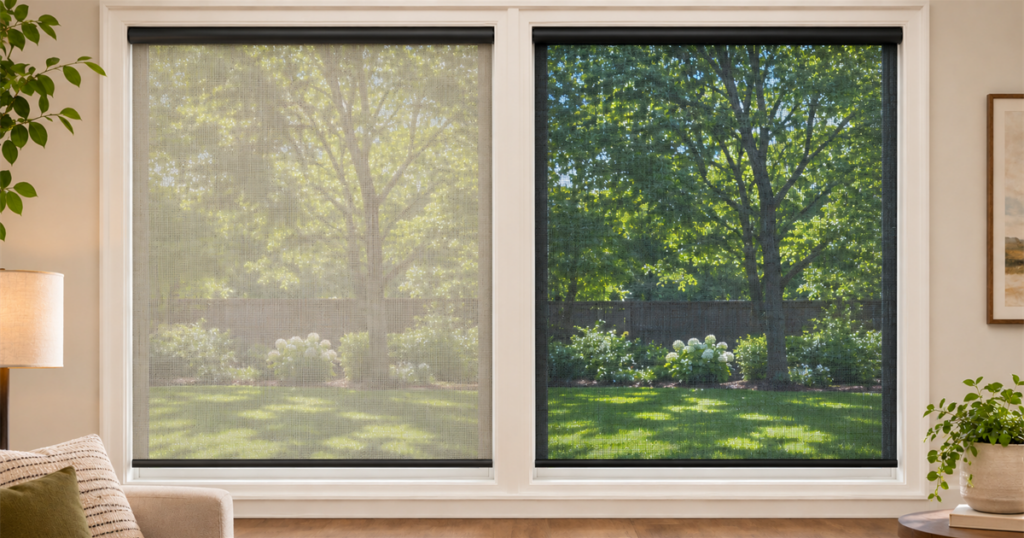
Choosing solar shade fabric means balancing openness, color, glare control, and the view you want to keep. A tighter weave generally limits the view more while providing stronger screening from sunlight. Darker fabrics often make the outdoor view easier to see, while lighter fabrics create a different balance of reflected light and interior appearance.
Neither openness nor color should be selected alone. Compare samples at the actual window, then confirm performance information for the exact fabric.
For Kansas City homes, that means starting with the room’s use and the time sunlight becomes a problem. A television area, dining space, and home office may need different fabric choices even when their windows look similar.
Choosing Solar Shade Fabric: What does solar shade openness mean?
Openness describes the proportion of open space in the fabric’s weave. It is a fabric characteristic, not a complete rating for every aspect of the installed shade. A lower percentage indicates a tighter weave. A higher percentage indicates more open space.
Graber’s current solar-shade product page presents options including 1%, 3%, 5%, and 10% openness. Confirm which percentages are available in the specific fabric and configuration you are considering.
Do not interpret the number as a universal light-blocking calculation. A 3% openness fabric should not automatically be described as blocking 97% of all visible light.
Visible-light transmission, ultraviolet performance, and solar-energy behavior are separate questions. Ask for the relevant specifications rather than converting one label into several unsupported promises.
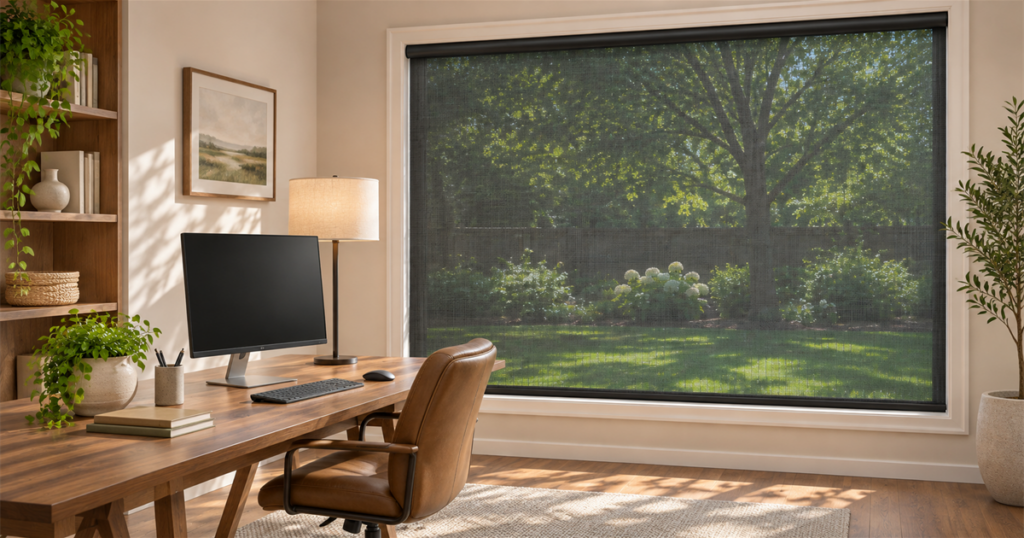
Choosing solar shade fabric: compare openness and color together
| Decision | What to compare |
| Stronger sunlight screening | A lower-openness sample |
| Greater connection to the outdoor view | A higher-openness sample |
| Clearer daytime viewing through the fabric | A dark fabric alongside a light alternative |
| A lighter interior appearance | Light-colored samples at the actual window |
| Nighttime privacy | A separate privacy solution where needed |
| Bedroom darkness | An appropriate blackout treatment and coverage plan |
Use the table to build a shortlist. The final choice needs a real sample test because weave, color, lighting, and viewing position interact.
A useful comparison changes one variable at a time. First compare two openness levels in similar colors. Then compare light and dark colors at the same openness.
Choosing Solar Shade Fabric: What should you expect from common openness levels?
Lower openness: start here for stronger screening
A 1% or 3% fabric can be a useful starting point when strong sunlight or screen glare is the main concern. The tradeoff is a more restricted outdoor view. Avoid assuming that the tightest weave will feel best in every room.
Test it while seated where you normally read, watch television, or work. A sample can seem acceptable when held close to the glass but feel different from across the room.
Middle openness: compare the balance
A 5% sample is worth including when you want to compare screening with outward visibility. Treat it as an option to evaluate rather than a universal compromise that suits every home. Your tolerance for brightness and your attachment to the view may differ from someone else’s. Ask how the exact color and fabric construction influence the result.
Higher openness: assess the view and remaining glare
A 10% sample may be relevant when maintaining a stronger connection to the outdoors is the leading priority.
Check whether the remaining brightness still interferes with screens or seating areas. Greater openness does not guarantee that the room will meet your glare-control goal.
Graber describes the general progression from tighter screening to greater outward visibility across these openness levels.
Choosing Solar Shade Fabric: How do light and dark fabrics change the view?
Color changes how noticeable the fabric appears between you and the outdoors. Darker solar fabrics often support a clearer perceived daytime view. Lighter fabrics can appear brighter against the window and may make the weave more noticeable.
Graber’s solar-fabric guidance describes lighter colors as reflecting more heat and light, with darker colors favoring outward visibility. These are selection tendencies, not a substitute for the chosen fabric’s performance data. See Graber’s solar and roller fabric guide.
Compare color from two positions: close enough to judge texture, and far enough away to judge the actual room experience. Also look at the shade beside your trim and wall finishes. A fabric can perform acceptably while creating a stronger visual contrast than you wanted.
Choosing Solar Shade Fabric: Why solar shades need a nighttime privacy plan
Solar fabric is an open weave. It should not be treated as a guaranteed privacy barrier after dark. The relationship between interior and exterior lighting changes through the day. Being able to see outward during daylight does not establish that people outside cannot see inward at night.
If privacy matters, discuss a separate opaque layer or another suitable treatment. Confirm how it will fit and operate with the solar shade.
Graber identifies pairing solar and roller shades as one way to combine daytime solar control with greater privacy. The exact arrangement still needs product and mounting checks. Review Graber’s privacy guidance.
Do not try to solve a bedroom privacy requirement simply by choosing a lower openness percentage.
Choosing Solar Shade Fabric: Separate glare, UV protection, heat, and blackout
These terms describe different outcomes. Glare is brightness that interferes with comfortable viewing or a task. Judge it from the seat or workstation where it causes a problem.
UV protection concerns ultraviolet radiation. Ask for the exact fabric’s specification rather than treating it as identical to visible-light reduction. Heat performance requires its own information. Avoid choosing by fabric color alone or assuming a particular reduction in room temperature.
Blackout concerns a much stronger light-blocking goal. An open-weave solar fabric is not a substitute for an appropriate blackout treatment.
For a fuller opacity comparison, use Rick’s Blinds products guide. Keep the solar selection focused on balancing sunlight screening and the retained view.
Choosing Solar Shade Fabric: Test samples at your Kansas City windows
A showroom-style comparison under even lighting cannot reproduce every condition in your home.
Use this practical sequence:
- Identify the window where sunlight is most troublesome.
- Write down the time and activity affected.
- Compare two openness levels with similar colors.
- Compare light and dark fabrics at the same openness.
- View the samples from your normal seated position.
- Check how the fabric looks with room lights on.
- Discuss nighttime privacy separately.
- Confirm the specifications of your final fabric.
For a home office, look at the screen while evaluating the sample. For a living room, sit where you normally watch television. Keep these notes with your final order details.
These checks turn a vague preference into a useful conversation about the room’s actual requirements.
Plan the whole opening, including operation
Fabric selection is only part of a custom shade. Ask how the proposed mounting arrangement affects coverage, side gaps, handles, and trim. Check how the roller assembly will look when the shade is raised.
For several adjacent windows, discuss alignment and whether the same fabric should be used across the group.
Do not assume every window needs the same openness. However, review the appearance of different choices before ordering treatments within one shared view.
If furniture makes the window difficult to reach, compare eligible control options. Motorization may be worth discussing, but compatibility depends on the product, dimensions, and selected system. A convenient control helps make the shade practical for everyday use.
How should you compare Graber fabric names?
When researching Graber Solar Shades, you may also encounter the terms graber solar roller shades and Graber LightWeaves Solar Shades.
Use those names to begin a product conversation, rather than assuming that every historical collection, fabric, or percentage remains available.
Ask for the current fabric name, color, openness, performance information, and applicable size limits. Confirm that the sample being approved matches the product being quoted.
This is especially useful when comparing an older online reference with a current sample book. A verified specification is more useful than a collection name alone.
Keep a written record of the approved sample, including its fabric code and color. If several rooms need different specifications, label each opening clearly. This simple order check helps prevent confusion between a fabric chosen for the view and another selected to address a stronger glare concern.
Frequently asked questions
Does 1% openness mean blackout?
No. It describes a tight solar weave, not a complete blackout installation. Discuss a separate light-blocking solution when darkness is the goal.
Is dark fabric always better?
No. Dark fabrics can favor outward visibility, but the right choice also depends on your interior appearance preferences and product-specific performance.
Can I use different openness levels in one home?
Yes, provided the proposed fabrics and configurations are available. Compare their appearance together when windows share the same room or exterior view.
Where should I start comparing Solar Shades Kansas City options?
Review Rick’s Blinds’ solar shades product guide, then prepare a shortlist of windows, glare problems, and view priorities.
Find the right fabric for your room
Rick’s Blinds serves Kansas City and the greater area with custom window-treatment guidance and professional installation. Schedule a free consultation to compare solar fabric samples, review privacy needs, and confirm a suitable configuration.